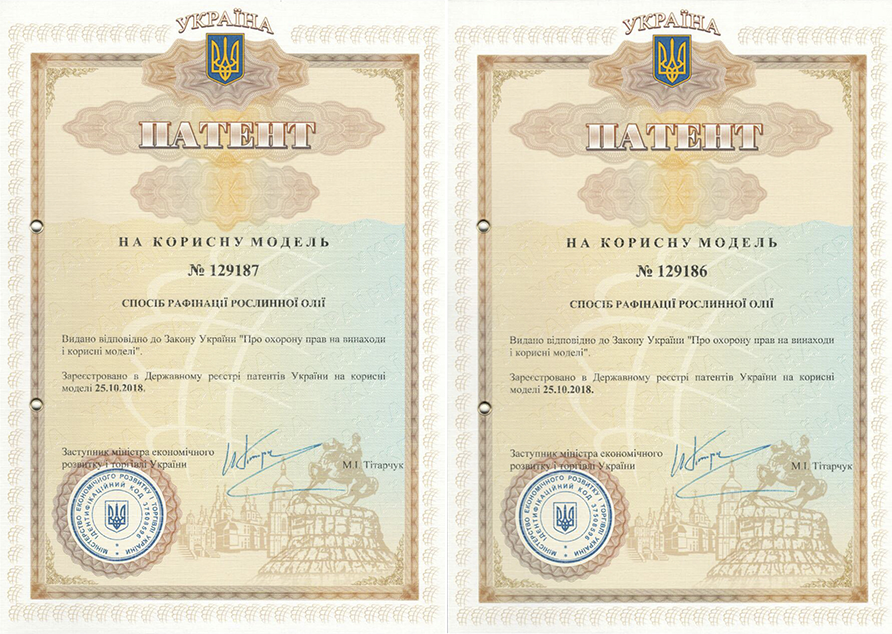
Direct refining of vegetable oils
The technology was developed for the refining of all types of vegetable oils with minimal energy costs and minimal losses of raw materials using simple equipment.
Existing refining technological chains are divided into several separate processes, i.e.
Hydration;
Winterization;
Neutralization;
Bleaching;
All these processes are technologically divided and require their own set of equipment, temperature conditions, and cleaning devices.
This technology is based on combining the main parts of the technological chain into one continuous process using Reagent-Coagulant 1 (RC1 or РК1). The main advantage of using RC1 over standard schemes is that waxes, hydrofuses, and soapstock remain on the filter in the filtrate during all stages of the process.
Description of direct refining technology
1. Oil with a temperature of 12 - 15°С enters Coagulator 1. With constant stirring at a speed of 17 rpm, the next elements are added:
- water, in an amount up to 1% of the total amount of oil;
- reagent-coagulant 1 (RK 1), in an amount of 250 g/t of oil;
2. Stirring continues for the next 30-40 minutes, resulting in hydration and winterization;
3. The calculated amount of a 25% alkali solution (NaOH) is added to the mixture with stirring at the same speed;
4. Stirring continues for the next 30-40 minutes;
5. The calculated amount of 10% citric acid is added to the mixture, stirring continues for 15 minutes.
Oil bleaching can be performed in two ways
First type
After citric oil processing, during the constant stirring, bleaching clay is added to Coagulator 1 in an amount of 5-7 kg per ton of oil.
Stirring continues for 15-20 minutes.
The mixture of oil and clay is filtered through a filter pre-washed with perlite. During the filtration, the oil is bleaching and gets clear from clay and other substances that determine the color of the oil, as well as from hydrofuses and waxes.
After the main filter, oil goes through a police filter to remove traces of clay and perlite.
As a result, we get oil with a color number of 7-10 mg of iodine.
The advantage of this type of direct refining is that the whole process can be performed in one piece of equipment.
Second type
The oil, processed with citric acid, is filtered through a filter pre-washed with perlite.
During the filtration process, the oil gets clear from hydrofuses and waxes. After the main filter, the oil goes through the police filter to remove traces of hydrofuses, waxes, and perlite.
The filtered oil enters the heat exchanger-recuperator to be heated to 40-50°С.
The heated oil is fed to Coagulator 2.
While stirring the oil, bleaching clay is added to Coagulator 2 in an amount of 5-7 kg per ton of oil.
Stirring continues for 15-20 minutes.
The mixture of oil and clay is filtered through a pre-washed filter. During the filtration, the oil is bleaching and gets clear from clay and other substances that determine the color of the oil. After the main filter, oil goes through a police filter to remove traces of clay and perlite. As a result, we get oil with a color number of 5-7 mg of iodine.
Characteristics of oil after direct refining
- No soap;
- No wax;
- Moisture less than 0,1%;
- The color number less than 12 mg of iodine;
- Transparency: transparent without sediment;
- Mass fraction of non-fat impurities - 0%;
- Mass fraction of phosphorus-containing substances - 0%;
- Taste and smell: common for a refined sunflower oil;
- The acid number less than 0.25 mg KOH / g (of a freshly produced oil);
- The peroxide value of 1/2O mmol/kg (of a freshly produced oil) is less than 6.0;
Advantages of direct refining
- Gentle oil heating;
- Minimal energy expenses;
- Simple technological scheme;
- Minimal quantity of equipment;
- Available supporting materials;
- Absence of hydrofuse and other oil by-products;
- Quick process of getting the end-product;
- Small production areas are required for all of the necessary equipment;
- Oil losses are negligible - only during the filtration, some small amounts of oil remain on perlite.
Patents