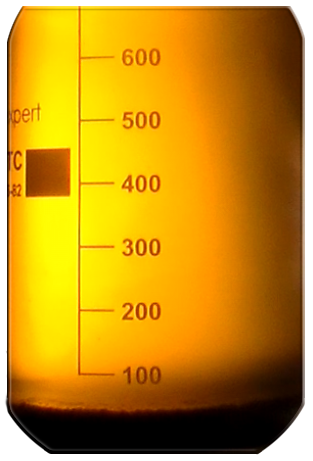
Процесс осаждения
Hydration without hydrofuse
You may ask - is this really possible? – The answer is - yes, and many of our customers, who used Reagent-Coagulant 1 (RC1 or РК1) were convinced in it. All vegetable oils contain a certain amount of phosphorus-containing substances. They are the remnants from oilseeds. By themselves, these substances are very useful and nutritious, but their presence worsens the presentation of the oil. They settle down in the lower layers and form a sediment.Usually, the sedimentation process is quite long. Therefore, under production conditions, the process of hydration is applied, i.e. the process of sedimentation of phosphorus-containing substances after treating the oil with an aqueous solution of a hydrating agent. It can be either pure water or an aqueous solution of salt, acid, alkali. The amount of water does not exceed 4% of the amount of oil.
Hydrofuse
Phosphorus-containing substances on a molecular level have hydrophilic and hydrophobic groups. One group «can combine»with water-containing substances, the other does not. The hydrophilic group combines with the water solution, swells and in the form of flakes settles on the bottom of the oil layer. The sediment, formed at the bottom - hydrofuse - is moist, oily, poorly stored, and requires multi-stage processing to extract oil and separate water.
Oil and the resulting sediment undergo a process, that can be illustrated with the next scheme:
Scheme of a standard oil hydration process

Video presentation of RC1
Tank Sludge Hydration
What does RC1 change?
RC1 simplifies everything, as illustrated below:
Water is added in an amount up to 1% of the total amount of oil, the resulting flakes completely absorb all water along with additional oil moisture.
After the sediment removal, oil is already completely dry. No additional costs are required for this process.
To get a more detailed understanding of how the hydration process occurs with a reagent, read a detailed article on dry hydration